
An Analysis of the 2026 National Policy Framework for AI
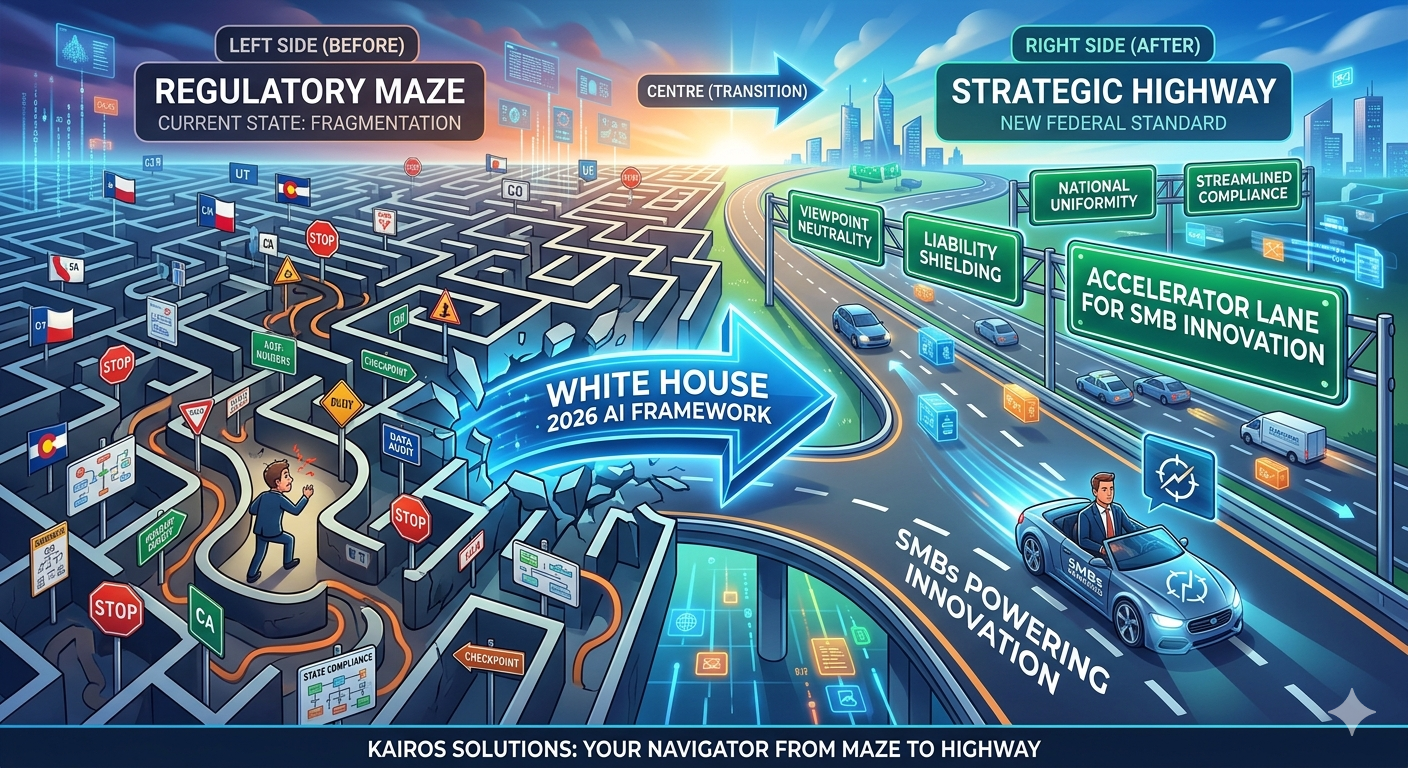
The landscape of American artificial intelligence shifted on March 20, 2026. The White House released its National Policy Framework for Artificial Intelligence to move beyond localized oversight. This federal mandate prioritizes industrial speed and national competition. It fundamentally restructures the rules for every modern enterprise. Kairos Solutions understands these new pressures and helps your business lead through this transition.
The New Federal Standard
The 2026 Framework relies on federal preemption. This policy intends to invalidate the current patchwork of state laws in places like California and Utah. The administration wants one predictable regulatory environment to ensure national growth.
The framework establishes three core pillars. First, it enforces uniformity to keep American companies competitive globally. Second, it proposes liability safe harbors to protect innovators from legal threats that slow down development. Third, it mandates viewpoint neutrality to stop government agencies from forcing specific political filters onto AI models.
Industry Reactions
Major AI labs generally support this "one-rule" approach. Each company sees a specific strategic advantage in these federal guidelines.
Google and Microsoft: These companies praised the new "Regulatory Sandboxes" and faster energy permitting. Google argued that federal leadership prevents a fragmented landscape from stopping high-level development.
OpenAI: This group supports the framework's stance on data usage. They view the federal guidelines as a defense of fair use for training the next generation of models.
Meta: Leadership at Meta highlighted the anti-censorship pillars. They believe these rules protect open-source innovation and ensure diverse outputs.
Critical Views: News outlets like The New York Times warn about an accountability gap. Critics argue that light regulation might leave consumers with less protection than they had under state laws.
The Kairos Advantage: Navigating X, Y, and Z
Industry giants find 50 different state laws difficult to manage. Small and medium-sized businesses face an even higher hurdle. Kairos Solutions translates this high-level policy into three practical advantages for our clients.
X: Ending Regulatory Guesswork
Businesses rarely have the budget to track every changing state compliance checklist. Kairos provides a clear vantage point by designing AI implementations that align with federal standards from day one. We focus on transparency now so your investments do not require a costly retrofit later this year.
Y: Building Resilience
Safe harbors protect the people who build AI, but the businesses using it still face operational risks. We turn the federal transparency suggestions into your primary advantage. Our Value Realization Framework uses human-in-the-loop safeguards to ensure your automated processes remain reliable and explainable.
Z: Modernizing Without Vendor Lock-In
The framework calls for removing outdated barriers to innovation. Our Legacy Modernization service helps you shed the SAS and move to open-source frameworks like Python or R. We build an agile technical foundation so you can use agentic AI without getting stuck in one proprietary ecosystem.
The 2026 National Policy Framework simplifies the legal landscape and lowers the barrier to entry. Kairos Solutions bridges the gap between complex federal policy and the practical AI tools your business needs. We turn these new standards into your best catalyst for growth.
