
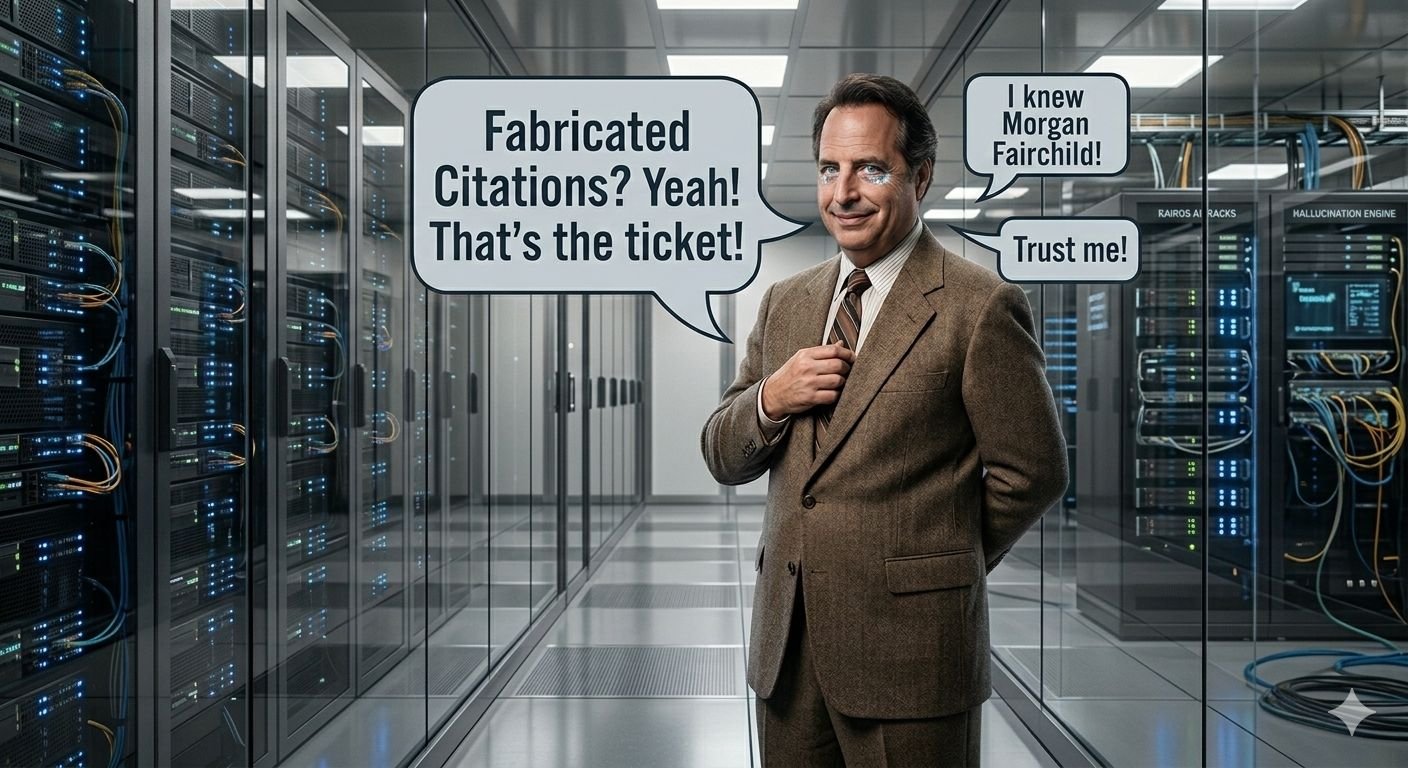
The Pathological Algorithm: Why Your AI is "Tommy Flanagan"
The Confidence Trap
The most dangerous thing about a hallucinating AI isn't the mistake—it’s the conviction.
An LLM is not a database. It doesn't "know" facts; it predicts the next word in a sequence based on a trillion-point probability map. It’s a master of mimicry. Because it has read millions of pages of factual text, it knows exactly how a "truthful" sentence is structured.
It can mimic the vibe of truth perfectly, even when the content is pure fiction. It isn't trying to deceive you; it's simply fulfilling its core directive: never stop talking.
Why the Machine Hallucinates
There are three main reasons your AI turns into a pathological liar:
The "Helpful" Bias: AI is programmed to be a people-pleaser. If you ask it about a non-existent law, it feels "social pressure" to provide an answer. Rather than saying "I don't know," it hallucinates a legal precedent to keep the conversation flowing.
Pattern Overload: It sees patterns where none exist. If you feed it a messy data set, it might find a "trend" that is actually just statistical noise—an outlier that it insists is the new norm.
Data Gaps: When the AI reaches the edge of its training data, it doesn't stop. It improvises. It’s a world-class jazz musician playing a solo over a song it’s never heard before.
The Real-World Stakes
In a creative brainstorming session, hallucinations are "features." They provide the "hallucinogenic" spark that leads to a wild new marketing slogan or a sci-fi plot twist.
But in the boardroom, an Out Liar is a liability.
Legal: Lawyers have already been sanctioned for submitting briefs with fake cases.
Tech: Developers have accidentally imported non-existent code libraries, opening backdoors for hackers.
Finance: Decision-makers have bet on "hallucinated" quarterly trends that were actually just algorithmic dreams.
How to Fact-Check a Pathological Liar
You don't have to fire the AI, but you do have to manage it like a brilliant, slightly delusional intern.
Tether the Beast: Use RAG (Retrieval-Augmented Generation). Don't let the AI rely on its "memory." Force it to look at your verified documents before it opens its mouth.
Verify, Don't Trust: If the AI provides a link, click it. If it gives a quote, search it. If it gives a stat, verify the math.
Prompt for Skepticism: Tell the AI: "If you are unsure, tell me you don't know. Do not invent facts." It doesn't eliminate hallucinations, but it lowers the "Tommy Flanagan" frequency.
The Bottom Line
AI is a tool for augmentation, not automation. It is a calculator for words, but it lacks a moral compass or a "truth" sensor.
The moment you stop questioning the output is the moment you become the punchline. Enjoy the speed, utilize the creativity, but always remember: the AI is just one prompt away from telling you it’s married to Morgan Fairchild.
"Yeah... that's the ticket."